



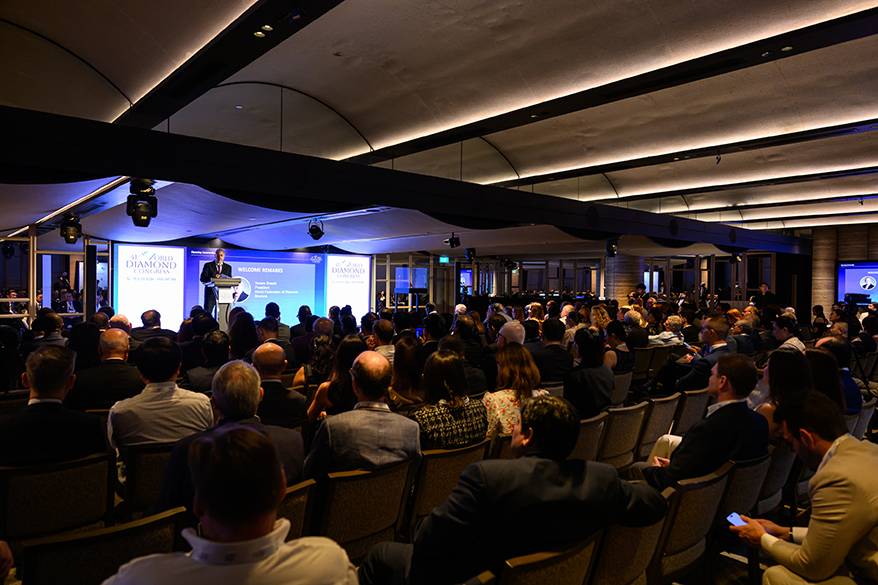

The 41st World Diamond Congress opened in Singapore on July 13, with industry leaders and government representatives from major diamond-producing countries calling for renewed efforts to build consumer demand for natural diamonds.
Hosted by the Diamond Exchange of Singapore (DES), the Congress is being held in Singapore for the first time since the 24th World Diamond Congress in 1988. The 2026 event runs from July 12 to 15 and brings together representatives from across the diamond trade.
Opening the Congress, Fabio Cascapera, Chair of the Congress Organising Committee and President of DES, reflected on the changes the industry has experienced since the previous Singapore Congress.
“At that time, I was a young man, full of confidence about the future of our wonderful industry,” Cascapera recalled. “While I am not that young anymore today, and certainly not as light on my feet, I am still passionate about diamonds and thankful for what diamonds have done for all of us here.”
He encouraged younger members of the industry to remain engaged with the sector and concluded: “Don’t let anyone discourage you.”
Yoram Dvash, outgoing President of the World Federation of Diamond Bourses (WFDB), also addressed delegates at the opening ceremony.
“Who thought that such a small bourse could stage such a great and magnificent event!” Dvash said.
Ronnie VanderLinden, President of the International Diamond Manufacturing Association (IDMA) and President of the World Diamond Council, highlighted Singapore’s role as an international trading centre.
“Known as a global crossroads, Singapore perfectly mirrors the spirit of our industry, a place where brilliance, precision, and global connection come together,” he said.
Rebuilding Consumer Demand
VanderLinden’s address focused on consumer demand for natural diamonds.
“Over the past twenty years our industry has worked incredibly hard. We have improved standards. We have strengthened consumer confidence. We have invested in technology. We have done important work to protect the integrity of our product. And we should be proud of that. But let’s be honest with ourselves. Somewhere along the way, we forgot how to create desire. We became focused on explaining natural diamonds. We became focused on defending natural diamonds. We became focused on proving what natural diamonds are. What we stopped doing was making people want them. That is the challenge. Not because there is anything wrong with the product. There isn’t. Natural diamonds remain one of the most extraordinary products in the world. The challenge is that we stopped telling the story in a way that creates desire.”
The comments come as the diamond trade continues to address changes in consumer purchasing behaviour and competition from laboratory-grown diamonds. The distinction between natural and laboratory-grown diamonds has become an increasingly important part of the consumer conversation, while retailers are also considering how diamonds can be positioned for occasions beyond traditional bridal purchases.
Recent research from De Beers found that non-bridal occasions accounted for three-quarters of US natural diamond demand in its 2026 consumer study. The research also found that Gen Z accounted for 23% of natural diamond demand value in the US, with social media playing a role in how this group researches purchases.
For jewellers, the discussion around storytelling relates to how natural diamonds are presented at retail, including their provenance, characteristics and relevance to different purchasing occasions.
African Producers Seek Investment
Botswana’s Minister of Minerals and Energy, Bogolo Joy Kenewendo, and Angola’s Secretary of State for Mining, Jânio da Rosa Corrêa Victor, also addressed delegates during the opening ceremony.
Both government representatives invited delegates to visit and invest in their respective diamond industries.
Kenewendo also addressed the need for the industry to communicate the role of natural diamonds to consumers.
“We must not lose sight of the larger question confronting our industry. The question is not whether natural diamonds can survive. They will. The question is whether they will continue to occupy a meaningful place in the hearts and minds of future generations. The answer to that question depends on us. It depends on whether we are willing to tell our story with confidence. It depends on whether we embrace transparency rather than fear it. It depends on whether we recognise that today’s consumers are not simply purchasing products; they are choosing identities, values and narratives. And it depends on whether we can demonstrate that natural diamonds continue to represent something that is authentic, enduring and meaningful in a rapidly changing world. I remain optimistic. I remain optimistic because the natural diamond industry possesses something that many industries spend years trying to create and can never fully achieve. We possess authenticity. We possess history. We possess a product whose story spans billions of years and whose impact has transformed lives across generations. Most importantly, we possess a story that remains unfinished. The next chapter of the natural diamond story will not be written by geology alone. It will be written by leadership. It will be written by innovation. It will be written by partnership. And it will be written by our collective ability to ensure that future generations understand not only what natural diamonds are, but what they mean!”
Kenewendo’s comments linked the industry’s approach to storytelling with changing consumer expectations and the need for greater transparency.
Singapore and the Asian Market
The Congress is also examining the role of Asian markets in the global diamond trade. The WFDB has previously said the event would address Asia’s manufacturing base and consumer markets.
The Congress website lists consumer marketing, trade regulations, ethical sourcing, financing and emerging technologies among the subjects being addressed during the event.
The focus on consumer demand and Asian markets comes as the diamond trade assesses changes in purchasing behaviour and competition from laboratory-grown diamonds. The industry is also examining how to communicate the distinction between natural and laboratory-grown diamonds and identify opportunities beyond traditional bridal demand.
The World Diamond Congress is being held from July 12 to 15 at PARKROYAL COLLECTION Marina Bay in Singapore.
