



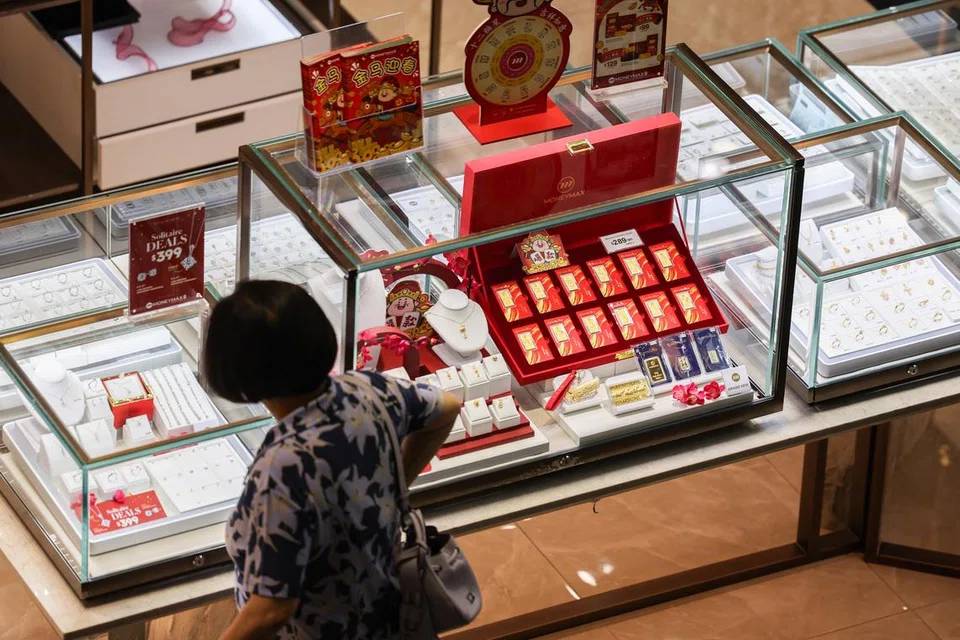

Gold retailers, bullion dealers and pawnbrokers in Singapore are responding to increased demand for precious metals by adjusting stock levels and expanding storage capacity, as geopolitical tensions in the Middle East and interest rate expectations influence buying behaviour.
Market participants report stronger interest in gold bars, coins and jewellery, alongside continued activity in silver and a rise in customers selling or trading existing holdings.
Price Movements and Market Drivers
Gold prices have seen notable fluctuations in recent months. The metal reached a record high of US$5,589.38 per ounce in January before easing, then rising again in early March following military developments involving the United States, Israel and Iran.
Movements in oil prices have also contributed to market uncertainty, with implications for inflation and interest rate policy. These conditions continue to shape demand for non-yielding assets such as gold.
Gregor Gregersen, founder of Silver Bullion, told The Straits Times that sales of gold and silver bullion in the 12 months to 1 March were approximately 350 per cent higher year-on-year.
“Physical demand remains high, but we have not seen a repeat of the surge that occurred after the January price crash,” he said.
“The war in the Middle East is broadly bullish for precious metals, but investors may currently be more focused on deleveraging riskier assets amid falling equities rather than adding safe-haven assets such as gold.”
Inventory and Storage Response
Retailers and bullion dealers report making changes to inventory and storage in response to sustained demand.
David Mitchell, founder and managing director of Indigo Precious Metals, told The Straits Times that demand at his business has risen more than 100 per cent in 2026 compared with the same period last year.
“We have seen more buyers than sellers over the past year, but we also are beginning to see more sellers entering the market, which is typical after strong price moves,” he said.
Mitchell added that refining and fabrication capacity in centres such as Switzerland, the UK and Hong Kong is under pressure, contributing to longer lead times and higher premiums on certain products.
In response, the company is maintaining higher stock levels of core items including 100g gold bars and one-ounce coins.
“In the near term, price action is being driven primarily by geopolitics and interest rate expectations – if the current conflicts expand or key supply routes remain disrupted, the market may remain elevated longer than many expect,” he said.
Silver Bullion is also expanding its storage infrastructure, increasing capacity to 2,500 tonnes through the construction of 22 additional vaults at its facility in Changi South.
“For 2026, I expect a revenue of around $2.5 billion, with an even split between gold and silver,” Gregersen said in his comments to The Straits Times.
ValueMax managing director (retail and trading) Yeah Lee Ching told The Straits Times that demand has increased for London Bullion Market Association gold bars and 916 gold jewellery.
“We have been a distributor of the world’s popular investment-grade PAMP Suisse bars for decades, and demand for the iconic ‘Lady Fortuna’ gold bar has been rising steadily since last year,” she said.
The company plans to increase its stock of PAMP Suisse bars, while also reporting higher footfall at some outlets. ValueMax recorded sales revenue of $425 million in 2025, up from $343 million the previous year.
Trade-In Activity and Retail Trends
Alongside purchasing, retailers report an increase in customers trading in older gold jewellery.
Angelina Lau, group general manager at SK Jewellery Group, told The Straits Times that more customers are returning to exchange items bought when gold prices were lower.
“Some choose to upgrade to newer designs, while others exchange a single heavier piece for multiple items such as gold jewellery or gold collectibles,” she said.
While buying activity remains stronger overall, trade-in volumes have increased as prices have risen.
Shifts in Customer Profile and Purchasing Behaviour
Retailers and pawnbrokers report participation across a wide range of age groups, with increased interest among younger consumers.
Lim Chun Seng, group general manager at MoneyMax Financial Services, told The Straits Times that customers in their 20s and 30s are showing greater engagement with gold as an asset.
“Transactions include 916 and 999 gold jewellery, as well as investment-grade products such as 9999 gold bars,” he said.
“We have also observed more transactions in smaller jewellery items such as pendants and earrings, reflecting how consumers are adapting their purchases in response to higher gold prices while still maintaining an interest in owning gold.”
Across the market, demand continues to cover both jewellery and investment products, with smaller denominations and lighter pieces becoming more common.
Implications for the Jewellery Trade
Current market conditions are influencing stock management, product mix and customer engagement strategies. Increased demand for bullion products is prompting retailers to hold more standardised bars and coins, while managing exposure to price movements and supply delays.
Higher gold prices are also contributing to greater trade-in activity, supporting the recycling of gold and enabling new sales through exchanges or upgrades. Demand for lighter-weight jewellery reflects ongoing price sensitivity among consumers.
Supply constraints at refining and fabrication level may continue to affect availability and premiums, requiring closer planning around inventory. At the same time, the expansion of storage facilities indicates sustained interest in physical precious metals.
A broader customer base, including younger buyers, points to continued overlap between jewellery purchasing and investment demand, with implications for product assortment and retail positioning.
